When I think why I feel compelled to create something expressive and original, I am left entirely without an answer that fully satisfies me. I have the definite urge to communicate an emotional message, but emotions are themselves lacking in definition or any observable status. It is probable that the ambiguity that surrounds emotional expression perhaps initializes the desire in us to map and take command of the unknown. To be the intrepid voyager to bring the indecipherable concepts of feeling to a place where others can directly understand the emotion you want them to. That you can portray a visceral concept using a method that allows the communication and eventual transfer of a usually personal and lonely experience.
Feeling is not normally a social event. Societally, we actively attempt to silence the unintentional expression of emotions. Without the consent of the listener, we rightfully feel that we would be infringing upon their privacy. Each member of a social structure typically exists in a limbo between their expressed feelings and the ones which they hold to themselves. Both because they don't want others to know, or they are unable to explain precisely what and why an emotional object actually is. The ability to translate the incommunicable seems, alluring to say the least.
Food for thought, my friends.
~V 1.0~
Showing posts with label thinking. Show all posts
Showing posts with label thinking. Show all posts
Sunday, September 8, 2013


Saturday, February 18, 2012
The Written Word
As a society, why do we always seem to gauge a person on their proficiency with the written word, through reports and essays? Adults are required to give multipage reports of themselves to even get someone to consider them for a job.
College undergrads must write a several hundred page thesis in order to prove that they understand a certain topic. Knowledge is not proven by an ability to write down information from other sources, the magic occurs when the ideas are used to synthesize new ones. That is not something that is recorded on paper, but merely the aftermath. I believe that in order for an accurate assessment to be made of an individual's proficiency, that we must depart from the ways of old (because papers have been written by college students for hundreds of years). I think that there are many individuals who are very successful, but would seem rather dull and silly if they were to try and show their genius on a sheet of paper. Success isn't something that someone can find on a sheet of paper. It is an intrinsic quality (along with genius) and if you try to measure of quantify it, we will end up with a very broken system of education and assessment of education. One very much like we have today.
So in closing. Let's find a way to teach kids better, and also a better way to make entirely certain that they have learned. I believe the first step to an educational utopia is personalization on the student's behalf. We shouldn't focus on things the student already knows and things which come easy to the student, but the things which don't. And to accomplish that goal, we need to depart from the current methods of education and testing. Writing papers needs to be saved for those points in time when giving an oral presentation or doing real world examples simply doesn't make sense.
Our educational system is a broken mess.
Tuesday, February 15, 2011
Crazy Thoughts: Size
Have you ever noticed that the structures of the infinitival small atoms are basically that of our solar systems and galaxy? I have pondered on this fact quite a bit, and wondered what it would be like if they were actually solar systems with lifeforms on the quickly rotating electrons. Since they would be so tiny, whole millennia would elapse in billionths of a second.
It's kind of an exciting idea, completely preposterous, but still exciting.
~V 1.1~
//If you have any topics you would like to see me write about, drop me a comment\\
It's kind of an exciting idea, completely preposterous, but still exciting.
~V 1.1~
//If you have any topics you would like to see me write about, drop me a comment\\
Friday, January 14, 2011
Thinking and Consciousness
How could one define consciousness? It is such a real thing to each one of us, but almost impossible to contrive what consciousness actually is. In that video, Henry Markram demonstrates his crazy awesome super-computer simulation of a Neocortical Column. While that is impressive, the brain is made up of millions of those neocortical structures which together do indeed give us thought, perception, emotions, and consciousness.
Now in the beginning said video Mr. Markram discusses several different theories asto what our friend consciousness might indeed be. Consciousness is actually a very ambiguous item when you try to define it. When actually does consciousness "begin" and "end"? When you can understand the world around you? Or when you are merely perceiving it with one or more senses?
Another item we need be considering is what thinking is. I believe we could say that thinking is "simulating" a situation in our minds, simply making a decision based on past experiences, or creating an idea. But what is a thought even made of and held, and for that matter, what and how are memories stored and retrieved? One theory upheld by Cheuk-Wah Wong (quite a fascinating man) is that a unit of thought is a collection of neurons with their connected synapses, known as a Thoughtset. Mr. Wong also theorizes that thoughts and memories are indeed the same, other than the fact that a memory is a thought "frozen" into the brain. This seems like an obvious logical step, but is quite important to develop our understanding of consciousness further.
Thoughtsets consist of two still hypothetical synapse types, the modulation and the content synapse.
A Contentset, is a group of 1000's of content synapses (d'oh) and these are believed to do the actual initiation and maintaining of a thought. Whenever a thought need be transferred to memory, the modulation synapses spring into action and work together with the content synapses to consolidate the thought into a memory. How this occurs is...a little UNKNOWN. But it is believed that our brains do this by:
So now that we have our memories stored, I think we should take on what consciousness is....herrmmm. Getting to the point sucks. ;) So consciousness, is being aware according to Mosby's Medical Dictionary, 8th edition (© 2009, Elsevier), is:
Now in the beginning said video Mr. Markram discusses several different theories asto what our friend consciousness might indeed be. Consciousness is actually a very ambiguous item when you try to define it. When actually does consciousness "begin" and "end"? When you can understand the world around you? Or when you are merely perceiving it with one or more senses?
Another item we need be considering is what thinking is. I believe we could say that thinking is "simulating" a situation in our minds, simply making a decision based on past experiences, or creating an idea. But what is a thought even made of and held, and for that matter, what and how are memories stored and retrieved? One theory upheld by Cheuk-Wah Wong (quite a fascinating man) is that a unit of thought is a collection of neurons with their connected synapses, known as a Thoughtset. Mr. Wong also theorizes that thoughts and memories are indeed the same, other than the fact that a memory is a thought "frozen" into the brain. This seems like an obvious logical step, but is quite important to develop our understanding of consciousness further.
Thoughtsets consist of two still hypothetical synapse types, the modulation and the content synapse.
A Contentset, is a group of 1000's of content synapses (d'oh) and these are believed to do the actual initiation and maintaining of a thought. Whenever a thought need be transferred to memory, the modulation synapses spring into action and work together with the content synapses to consolidate the thought into a memory. How this occurs is...a little UNKNOWN. But it is believed that our brains do this by:
"inducing expression of genes to change the polypeptides and influxes of the ionic channels in the postsynaptic membranes"hmmm...that's a little complicated. How about we simplify things a bit. "inducing expressions of genes", so a string of mRNA that contains instructions to "change the polypeptides and influxes of the ionic channels" eesh... well since the ionic channels are responsible for transporting the molecules which create the electrical impulses which Henry Markram has told us are thought. Then we can probably decide that what the Doctor is saying is that the actual charges and ability to pass charges are changed. This way, whenever the synapses are refired the memory will be recalled, yeah? So whenever a thought is being tended, it is usually just stored in the pre-frontal lobe, kept in our "short-term memory". Whenever it is stored in our "long-term memory" (whenever you can remember events and facts hours and days later) the hippocampus is stimulated. We can then safely say that the hippocampus is probably either linking your different senses together into one episodic memory that contains, all perceptions at the time of the memory, or that all the information is simply routed through the hippocampus when it is being stored. My vote is both. And would you look at that! If we examine this very....lofty diagram of the brain from an article by Cheuk-Wah-Wong, you will find that he agrees that the very thoroughly researched Limbic System is responsible for storing memories.
 |
| What we are interested in is mainly C, but the whole diagram is useful stuff |
a clear state of awareness of self and the environment in which attention is focused on immediate matters, as distinguished from mental activity of an unconscious or subconscious nature.So we can take that as meaning, you can think, you can know your own thoughts, and at least know that your environment exists. So only one sense, I guess, is all that is required for this "consciousness". THUS,we can decide that consciousness is the cycle of creating and cultivating new thoughts via stimulus from either the environment or from your own memory, making decisions about these thoughts and memories using other memories and decisions, storing these decisions and thoughts in your short-term memory, and then either recycling those units of thought
~V 1.01~
//If you have any topics you would like to see me write about, drop me a comment
Thursday, January 6, 2011
Word Inventing
Even through the English language contains 750,000 words, sometimes I cannot find a word that specifically expresses my emotions. Such as a really fun time: Funderful. That is more of a conglomerate though, instead an actually new word, like frindle from Andrew Clements. But even there, frindle is just another word for pen. So what I'm talking about is a honestly new word meaning something that cannot be described in one existing word. Ciggly: the shunning of a great gift, act of kindness, or other happiness.
I have already a few of the different types of word inventing, but I thought I might as well make a nice little list.
Renaming: just giving an existing object or idea a new word; Frindle
Combining: adding two or more words together in an abbreviated form, but is a completely unique idea; Funderful
Inception: haha tribute to the movie, but honestly a new a word uninspired by anything else; Ciggly
Shortening: combining two words as too make them shorter, like "del" in Spanish; wend (week-end)
Now that we have defined word inventing, I am going to have to admit that I really like word inventing! It allows you to be more understood, if people understand what your doing, and is usually quite funny in a conversation. However, of course this process takes some finesse to actually implement without just making yourself look annoying. You shouldn't ever start a sentence with a word in your mind that you WANT to use. You will look like a annoying prick. That is bad. You should only invent words when you have a thought in your mind, and can't find a word to express yourself. That is a truly exciting event, because you are now free to invent. beautiful.
I have already a few of the different types of word inventing, but I thought I might as well make a nice little list.
Renaming: just giving an existing object or idea a new word; Frindle
Combining: adding two or more words together in an abbreviated form, but is a completely unique idea; Funderful
Inception: haha tribute to the movie, but honestly a new a word uninspired by anything else; Ciggly
Shortening: combining two words as too make them shorter, like "del" in Spanish; wend (week-end)
Now that we have defined word inventing, I am going to have to admit that I really like word inventing! It allows you to be more understood, if people understand what your doing, and is usually quite funny in a conversation. However, of course this process takes some finesse to actually implement without just making yourself look annoying. You shouldn't ever start a sentence with a word in your mind that you WANT to use. You will look like a annoying prick. That is bad. You should only invent words when you have a thought in your mind, and can't find a word to express yourself. That is a truly exciting event, because you are now free to invent. beautiful.
~V 1.3~
//If you have any topics you would like to see me write about, drop me a comment
Sunday, January 2, 2011
Origami
Origami is another passion of mine. In its purest form it is the folding of a single square of paper into the likeness of an object or idea without cutting or tearing the paper. Now that we have these rules in place we can discuss the refined examples of the art form.
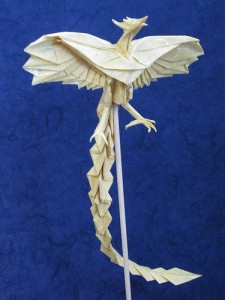
What you see in the picture is what I believe, the pinnacle of modern origami. The complexity of the model is completely beyond the scope of my imagination. It usually takes something around 40 hours for an experienced folder to complete. It has something around 1000 scales, a mustache, a tongue, eyebrows, feet, and everything else that a walking, fire-breathing dragon should come with.
HOWEVER, getting to this point has been a very long road. For the first few THOUSAND years after the invention of origami in Japan, the models rarely had more than 20 steps. Such as this Samurai hat:

As you can see how much more fluid and realistic the model on the left is compared to the right. BUT, the model on the left was also made with crappy paper and probably not the most experienced folder. Wet-folding still remains the best way to fold curves and form tight points, as in insects, bird beaks, and dragon talons.
After Yoshizowa came several other folders that changed the entire idea of origami. The foremost of these folders was probably Robert Lang. He introduced computers into the mix and created incredibly anatomically accurate models of all sorts of animals and insects. He did this by using programs which he wrote, to calculate the different folds required to create the base of a model. Hence the CP (Crease Pattern) was born. CP's are currently the easiest and most accurate way for folders to share models. Below is Lang's Bull Moose and it's CP.


The other major innovator I would list would probably be Satoshi Kamiya. His method of model creation is unlike any other folder I have even heard of. Satoshi starts by imagining what he wants the model to look like and then unfolds it in his mind!! It is surreal...The catch is he's only 29! His works include the above Ryujin, the Ancient Dragon, the Phoenix, and quite a few other mind boggling creations.
Now of course their were MANY MANY other major contributors to the art, but those are who I consider the most ground shaking.
~V 1.0~
//If you have any topics you would like to see me write about, drop me a comment\\
 |
| Satoshi Kamiya's Ryujin |
What you see in the picture is what I believe, the pinnacle of modern origami. The complexity of the model is completely beyond the scope of my imagination. It usually takes something around 40 hours for an experienced folder to complete. It has something around 1000 scales, a mustache, a tongue, eyebrows, feet, and everything else that a walking, fire-breathing dragon should come with.
HOWEVER, getting to this point has been a very long road. For the first few THOUSAND years after the invention of origami in Japan, the models rarely had more than 20 steps. Such as this Samurai hat:

Which has 8 steps. So that's pretty much how things stayed until the "father of modern origami", Yoshizawa, entered the picture. He was the the inventor of over 50,000 origami models and really started to actually be expressive with origami, and use it as you would any other medium to express yourself. He also contributed to the art my inventing a technique called wet-folding. While wet-folding, you actually wet the paper while folding it. (yeah crazy, wet-folding is folding wet paper...) Instead of creating a soggy, and torn mound of paper like you may think, when applied correctly, it creates some of the most beautiful origami creations I have ever seen. This technique helps create a very 3d shape which makes any model many times more realistic. ie
 |
| Dryfolded rose |
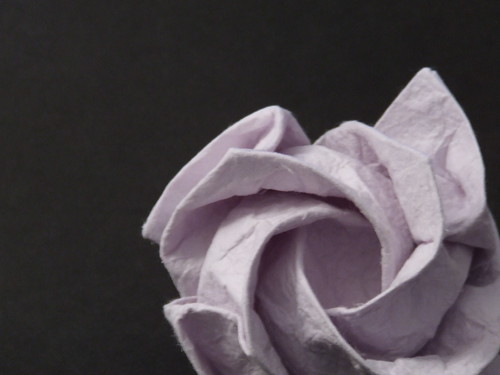 |
| Wetfolded rose |
As you can see how much more fluid and realistic the model on the left is compared to the right. BUT, the model on the left was also made with crappy paper and probably not the most experienced folder. Wet-folding still remains the best way to fold curves and form tight points, as in insects, bird beaks, and dragon talons.
After Yoshizowa came several other folders that changed the entire idea of origami. The foremost of these folders was probably Robert Lang. He introduced computers into the mix and created incredibly anatomically accurate models of all sorts of animals and insects. He did this by using programs which he wrote, to calculate the different folds required to create the base of a model. Hence the CP (Crease Pattern) was born. CP's are currently the easiest and most accurate way for folders to share models. Below is Lang's Bull Moose and it's CP.


The other major innovator I would list would probably be Satoshi Kamiya. His method of model creation is unlike any other folder I have even heard of. Satoshi starts by imagining what he wants the model to look like and then unfolds it in his mind!! It is surreal...The catch is he's only 29! His works include the above Ryujin, the Ancient Dragon, the Phoenix, and quite a few other mind boggling creations.

Now of course their were MANY MANY other major contributors to the art, but those are who I consider the most ground shaking.
~V 1.0~
//If you have any topics you would like to see me write about, drop me a comment\\
Subscribe to:
Posts (Atom)